 I live a mile and a half from the spot where Renée Good was killed by our government on January 7th. Less than three weeks later, Alex Pretti was shot in the back by masked and heavily armed federal agents in front of my family’s favorite neighborhood doughnut shop. I have two children who attend Minneapolis Public Schools, where they have been practicing “code yellow lockdowns.” These are drills in which kids—the ones whose families have not switched to hastily executed online learning for fear of their children getting used as bait to lure vulnerable family members into the streets or coming back to empty homes—attempt to go about their normal school day with the knowledge that the building has been made into a fortress for their protection. Protection from their own government.
But the story of Minneapolis, as has been beautifully documented in thousands of images, stories, and articles, is not one of fear or despair, but of fierce love, tenacity, and bravery. And despite our relatively small numbers, Unitarian Universalists have been appearing in these stories over and over again. It is not a coincidence. Our theology—of radical interdependence, universal human dignity and worthiness, and responsibility to act on and for love—turns out to be the ultimate weapon against authoritarianism.
In his 1960 article “Pilgrimage to Nonviolence,” Rev. Dr. Martin Luther King Jr. spoke of love as the central principle at the heart of nonviolent resistance. “In speaking of love at this point, we are not referring to some sentimental or affectionate emotion… we speak of a love which is expressed in the Greek word agape… Agape is not a weak, passive love. It is love in action. Agape is love seeking to preserve and create community. It is insistence on community even when one seeks to break it. Agape is a willingness to sacrifice in the interest of mutuality.”
Yes, the people of Minneapolis are scared. People are being beaten and abused, people are being taken, and people are being killed. Our streets are being flooded with an intentional spectacle of viciousness and cruelty meant to divide us and frighten us into passivity, overwhelm, and despair.
But Minneapolis is also full of love in action. There is hope in the fact that, in King’s words, “the continuing community creating reality that moves through history” is moving through Minneapolis right now – whether you call it, as King did, the Holy Spirit, or you call it the Spirit of Life, or you understand it as the best of our common humanity.
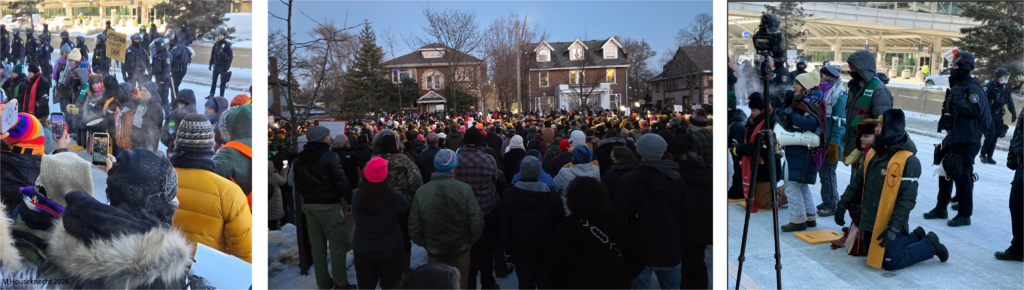
Thousands of people are patrolling the streets, monitoring bus stops, delivering groceries, watching each other’s kids, distributing whistles, teaching, and training one another. They are waking up at 4:00 in the morning to stand on freezing street corners, shifting work schedules, foregoing comfort, and increasingly risking their own safety because they recognize that they are interdependent. They are seeking to preserve and create community. They are willing to sacrifice in the interest of mutuality: Agape.
The most valuable piece of advice I was ever given was to worry less about what I should do and focus on who I am called to be. Not because what I do doesn’t matter, but because of how much it does matter. Who I am determines what I do, especially under pressure—in times like these.
The idea that “we are caught in an inescapable network of mutuality, tied in a single garment of destiny,” may be the most savagely beautiful and terrifying thing I can imagine right now. And yet, it is the cornerstone of my faith. So, who am I called to be?
When I ask myself what I should do, I can quickly become overwhelmed. The need is enormous, and it is easy to get lost in questions of strategy and effectiveness. But when I ask who I am called to be, I can focus on how I show up to other people, grounded in my values. Every successful movement for resistance and change included not only dissenting leaders, but also cooks, healers, drivers, organizers, artists, and childcare providers.
Something I have heard a lot lately is, “No one can do everything, but everyone can do something.” What I want to add is that it matters that our “somethings” are connected. We need to remember that who we are is, fundamentally, people who center the principle of love because we have faith in its power. “Love, agape,” King said, “is the only cement that can hold this broken community together.”
This is a time to claim our moral authority by taking our place among communities of faith and religious leaders, as demonstrated by the acts of nonviolent civil disobedience that many UU clergy, including Unitarian Universalist Association President Rev. Dr. Sofía Betancourt, have taken in recent weeks. Unitarian Universalists were among the core organizers of the call for faith leaders to come to Minnesota to witness what is being tested here and to learn from our community’s response. These actions have garnered national and international attention, bringing new energy to the fight to end support for the federally funded goon squads terrorizing our cities and harassing and kidnapping our immigrant neighbors and family members.
_______________________________________________
The world has seen many tyrants, and this country was born out of both a rejection of tyranny and the failure to apply the high-minded principles of life, liberty, and the pursuit of happiness to all people. The original sins of this country are the intertwined roots that made this current assault on our immigrant, Black, and brown neighbors possible. But that means we also have leadership to look to – those who have never stopped resisting, digging out those intertwined roots.
Again, we can look to Dr. King for an understanding of both the nature of those roots and what it means to embody, to be, the thing that overturns them. King’s words from 1967 about the existential dangers of the war in Vietnam are still relevant today: “When machines and computers, profit motives and property rights are considered more important than people, the giant triplets of racism, materialism, and militarism are incapable of being conquered.”
We are still fighting the same giant triplets, and here in Minnesota, we are finding ourselves on just one of several frontlines. We topple the giant triplets by showing who we are. Every act of solidarity is an act of resistance.
Racism: Like other fascist regimes before them, racism is the tool the current administration uses to create an “us” versus “them,” an enemy to fear. We resist it with every act of mutual care—and I mean not just charity, but mutuality, in which we recognize that our safety is bound up with one another, just as our liberation is.
We resist racism by believing people who have been marginalized and intentionally made vulnerable when they tell us what they need. We resist racism by following the leadership of the communities most targeted, and by shifting risk*, knowing that simple actions like buying groceries carry grave risks for some right now, but not others, based on the color of our skin.
*I want to make a special note here: The trans community has always borne high risk for the act of showing up boldly and bravely in the world as who they really are. Our trans beloveds need our support, too, and they need to know that they are already enough.
Materialism: Our consumer culture bears considerable blame for our descent into open oligarchy. This year we have seen that the corporate billionaires will turn on us the instant the political winds change, and this assault on our communities would not and could not be happening without their complicity and active support. A company is not a person and therefore has no morals or moral agency. But we exercise moral agency when we spend our money and offer our labor—and, in this attention economy, when we decide where to get information and how to share it with others. Economic noncooperation is something that everyone can participate in.
Militarism: “We had whistles. They had guns.” Many of us are haunted by these words from Becca Good, Renée’s wife. Yes, they have guns, but we have the tools of community, of sticking together, and of courageously locking arms. These are the tools of agape. Know your rights and the rights of others. Learn to be a lawful observer. Do not let anyone’s rights be trampled in the shadows. We resist militarism every time we expose the violence being unleashed on our neighbors and refuse to take the bait—when they want us to choose hate, and instead we embody love.
And here is the most important part: We’re not doing it alone. Our theology of interdependence and deep conviction in the inherent sacredness and worthiness of every human being is the bedrock from which we proclaim, with each deed and in our loudest voice, that we will not abandon each other out of fear or despair. They want us to feel alone and weak, but we are neither.
These acts to defend and strengthen our diverse communities—in solidarity with other faith traditions and under the leadership of those Black, brown, and Indigenous communities that have already demonstrated resilience in the face of state violence—are what democracy looks like at its best. They are what we have been preparing for in local democracy action teams and through mapping our congregational assets and relationships. If we are all but one and equal parts of a single garment of destiny, it is within our power to demonstrate that not only will we not be divided—we cannot be.