This is, first and foremost, a message of hope, drawing lessons from resistance movements whose stories have already been written to provide context and to call for effective political resistance through collective action today. Resistance work is hard, at times dangerous, and can feel disjointed, devolving into factions before finding its footing to achieve its preeminent goals, with numerous examples throughout current and ancient history. We will look at two case examples of resistance amongst the many in modern times: The French Resistance during WWII, and the Polish Solidarity movement (1980), and implications for building a united resistance movement in America.
Why are we going with these two examples? Given how resistance has gone over the past two centuries, it is possible to understand how patterns of resistance form and ways to compare them. Based on my interactions with French experts with lived experience of the French Resistance and my own direct observation of the Polish Solidarity Movement, it can be seen that successful resistance unfolds in comparable patterns.
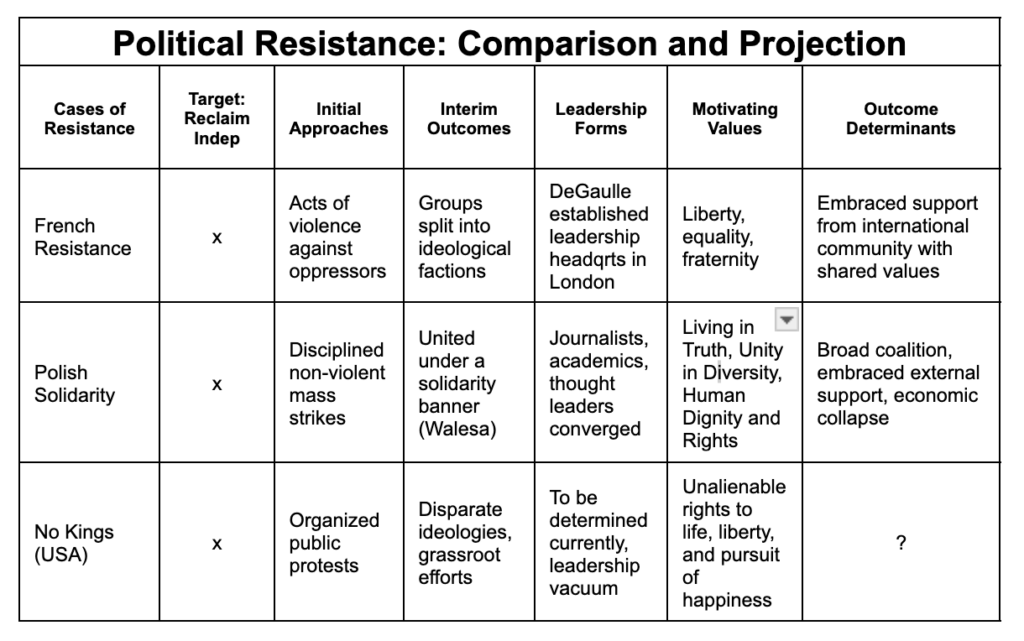
Below is a table that classifies notable characteristics of the phenomenon of resistance, including a comparison of the French Resistance, the Polish Solidarity, and the projection of the current American process.
French Resistance
In June of 1940, the German Wehrmacht overran France, fully occupying its northern region, imposing military authority and hardship, leaving the populace struggling to get by. Prior to the invasion, La Resistance was the furthest thing from anyone’s mind. It was born of necessity to regain independence, and protect deeply rooted French values: Liberte, egalite, fraternite, which emphasize individual freedom, equal rights, and social solidarity. French disruption efforts were highly effective, serving as force multipliers that helped Allied forces oust German troops from occupied territories.
Importantly for America’s unfolding resistance story, French resistance efforts were not always coordinated, nor were strategies agreed upon. Factions emerged, motivated by different ideologies: Nationalism, fascism, and communism. But ultimately, the hard-won French ideals dating back to the 18th-century French Revolution served as a galvanizing force, helping disparate efforts coalesce into a united resistance and prevail. Eisenhower said of the French Resistance that these efforts equaled having a “third division” aiding the efforts of the Allies. Independence was regained through recognition of the strength and inherent wisdom of interdependence. A valuable lasting lesson indeed.
Polish Solidarity Movement
By 1980, many Poles had become very dissatisfied with Communist rule. Normal household and life goods were in short supply, and even for those with funds, resources were not readily available, if at all. As is well documented, the shipyard workers of Gdansk, through a protest led by Lech Waleza established their resistance under the banner of Solidarity. Solidarity as resistance spread rapidly throughout much of Poland. The Communist Party declared Martial Law, imposing further hardships and restrictions on movement. As the 1980s wore on and life became increasingly difficult, the number of people in the Solidarity movement grew, with estimates putting its share of the population at 80% by the mid-1980’s, including academics, journalists, and other expert opinion leaders. Adding to the gravitas of the moment, Pope John Paul II spoke out on behalf of Solidarity and the plight of the people, as well as President Ronald Reagan, who saw the Solidarity Movement as a key component of his anti-communist foreign policy, providing funding, imposing sanctions, and conducting advocacy campaigns. By the late 1980s, the power of the Solidarity Movement was evident, and holding free and competitive elections to the Polish parliament and overturning communist rule were in view. Singularity of purpose, embracing the support of like-minded leaders with shared visions of democratic ideals, and defending human dignity and freedom were key.
Where do we Americans find ourselves in this moment? Rightly or wrongly, America has often been held up as the beacon of democracy, arbiter of freedom, and the one taking the moral high road in a sea of challenges. It would have seemed antithetical just a decade ago to suggest America would become a nation-state in need of not only internal, but external guidance to reign in the feckless actions of an unmoored administration to restore America’s creedal foundations. But here we are. As inspiring as our foundational principles, as iterated in the 1776 Declaration of Independence, are: Life, Liberty, and the pursuit of Happiness, considering the previous examples of the French Resistance and Polish Solidarity Movement, our system warrants re-examination for inclusivity, moving from staunch individualism to one of healthy interdependence with the global community.
For example, the release of the Epstein files has revealed on an international scale the power of the elite, and the lengths to which the system of division, dehumanization, and privilege will go to protect itself. The European response is shaming the woeful lack of American response, and a harbinger of how far we have fallen from what were once thought to be immutable American ideals of justice and accountability.
Do we have the fight in us to right our ship?
The good news is that there is growing resistance in society and government institutions, most notably led by liberals and progressives on the political left, including “No King’s” demonstrations and resistance to ICE. Groups are organizing protests and outreach to Congress, imploring members to do their job and stop this effort of autocratic control by the current administration. Many of you are already a part of this.
The Supreme Court’s recent decision striking down tariffs as illegal pushed back against the current administration’s power grab, bringing the Unity theory of presidential power into question. Additionally, the lower courts are aiding the pushback, including barring the FTC from dismissing cases as an independent regulatory body and staying ICE incursions.
Congress, imbued with the authority to facilitate the budget-making process, is pushing back, restoring many of the cuts imposed by the current administration, and the current budget now resembles past budgets.
Many disgruntled civil servants who have been laid off are entering politics, running for public office. They bring a wealth of knowledge and experience working within government, skills that will make them effective committee members, offering a historical perspective and ideas for improvement and change based on their career experience.
The stories of the French resistance and Poland’s Solidarity movements have been told. America’s resistance efforts are yet unfolding. There are numerous examples in our American experience that underscore that collective resistance works. Are the individualistic American values of life, liberty, and the pursuit of happiness enough to keep a collectivist resistance going to right the system?
Our emerging resistance is still fledgling. We are not independent actors on any issues; financially, environmentally, socio-politically, or ecologically. There is power in recognizing this interdependence to bring freedom, peace, and equality within our own country and among nations. Valuable lessons from history.
Together, we can do great things and bring things back into balance.
We need you.
 Kenneth D. Mitchell is a member of the UUSJ Democracy Action Team. He was attached to the Grand Ecole of National Administration in Paris, where he was focused on French History and Government Administration. During the 1980’s, he was an observer and participant in the Solidarity Movement in Poland.